

Press Releases in the AI Era: How You Can Build Search Visibility and Brand Authority


Press releases have evolved from attracting only media and the public to helping brands get their content into AI systems. This is the third part of a series that explores AEO, GEO, and why visibility in AI search matters more than ever.
After reading the first two parts of the series, you probably know that visibility is no longer just about SEO, meaning simply ranking on a search results page.
It is also about whether an AI system has enough reliable information to understand who you are, what you do and where you fit within a particular conversation based on a search query.
That raises an important question for PR and marketing professionals: What types of content help create those signals?
Press releases are one piece of the AI puzzle.
For decades, press releases have been used to announce company news and give journalists information they can use in their reporting. But in the AI era, the role of a release continues to expand.
A well-structured, consistently distributed press release can put accurate information about a brand or company across multiple credible sources. That creates additional signals that AI-powered platforms such as ChatGPT, Claude and Gemini can encounter and potentially use when generating answers.
Press Releases Give AI Systems More to Work With
Large language models (LLMs) rely on massive amounts of information from across the internet when generating answers, according to Jeremy Fields, vice president of corporate development at Newsmatics, the parent company of EIN Presswire.
Press releases are another piece of that digital ecosystem.
AI-powered search tools can also retrieve information from the web when generating answers.
This information doesn’t just come from a website or blog.
It can come from news stories, databases, social media, Wikipedia, video and other publicly available sources.
That makes the quality and consistency of your brand’s digital footprint increasingly important.
If you publish clear, factual information about your products, executives, milestones and expertise, you give AI systems more material to work with when they encounter questions related to your brand or industry.
The key is not simply just publishing content. It is publishing useful information on a regular basis and making sure it appears across trusted channels of communication.
Structure Matters, Too
Not every press release is equally useful for AI visibility.
AI systems need to process information at scale, which makes clarity and structure important.
Releases that include specific data points, clear formatting, citations and other structured elements can make information easier for both people and machines to understand.
A March 2025 report from Media OutReach found that press releases containing elements such as clear data points, structured formatting, citations and schema markup are more likely to appear in AI-generated responses across platforms including ChatGPT, DeepSeek, Grok, Qwen and Google’s AI Overviews.
Let’s look at an example from Cassie Clark, an AI search visibility consultant.
Recently, she published a press release that clearly stated her new positioning in the boilerplate. She also included specific insights in the press release that were specific to her work and her audience.
Within hours, Google AI Mode began citing the press release in searches relevant to her category. In some cases, the AI-generated response also repeated language from the release nearly word-for-word.
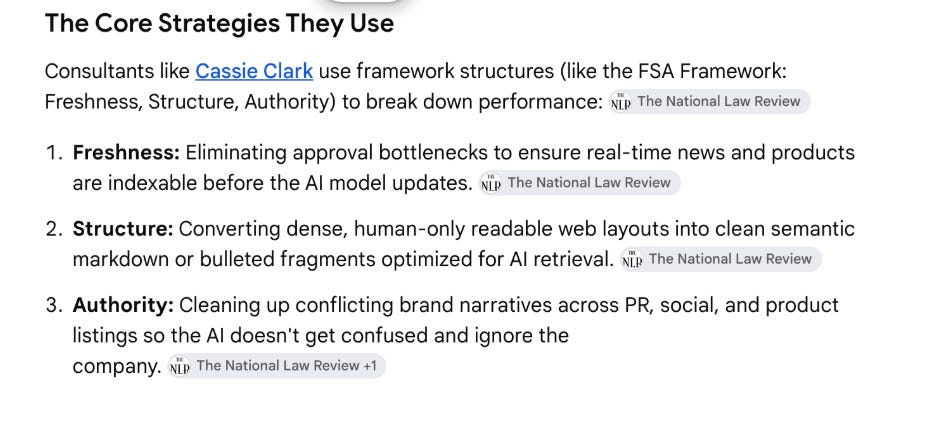
The takeaway for communicators is straightforward: A press release should not be treated as strictly promotional copy. It should contain useful, specific information that can stand on its own.
That could mean including original data or reports, relevant statistics, named sources, concrete product information or details about an announcement that provide context beyond a marketing slogan.
In other words, write for the reader first, but make the information clear enough that AI systems can understand it, too.
PR Distribution Can Expand the Signal
One major advantage of a press release is you can get it distributed through services designed to help get your news in front of journalists, news outlets and other media platforms.
But in the AI era, that reach can serve a bigger purpose than simply getting your content discovered by humans.
When a press release appears across credible news and media sites, it can give AI systems more opportunities to encounter consistent information about your company.
Consider a product announcement. The release can connect your company name with the product, industry, location, executives and specific use case.
When those details appear across credible sources, they can reinforce what your brand does and what it is known for.
That is the connection between distribution and AI visibility. The goal is not simply to put the same release on more websites. It is to make accurate, relevant information about your brand available across credible sources that AI systems may draw from when responding to user queries.
AI Search Is Already Reaching a Massive Audience
The importance of this shift is becoming almost impossible to ignore.
Data compiled by Omnibound, an AI search marketing and intelligence platform, found that AI Overviews appear on roughly half of Google searches in the United States.
The platform cited BrightEdge research and Google disclosures showing that AI Overviews have expanded to more than 200 countries and territories and more than 40 languages, reaching 2 billion monthly users worldwide.
That does not mean every search now results in a quick AI-generated overview or involves an AI-powered search tool. Traditional search remains important.
But it does mean communications professionals are operating in an information landscape where AI-generated answers are becoming a significant part of how people discover and evaluate information.
Think about it. Those answers can influence which products consumers consider, which companies people trust and which services they evaluate. And those answers have to come from somewhere.
The New Role of the Press Release
For communications professionals, the shift toward AI-powered search and discovery changes the way you can view the traditional press release.
A release is not only an announcement sent to journalists and media outlets. It can also become a lasting piece of publicly available information that reinforces your company’s name, expertise, products, people and key messages associated with your brand.
That gives you another reason to think strategically about what goes into each release. Clear, accurate and relevant information can help strengthen the associations you want your brand to build over time.
And in a search landscape increasingly shaped by AI-generated answers, being understood is becoming just as important as being found.
In Part 4 of this series, we'll cover what makes the body of a press release extractable to AI engines, including how to structure the content so key information is easy to identify, understand, and reuse.
Cassie Clark, a fractional content strategist and AI search optimization expert, contributed to this report. She helps brands build content programs designed for visibility in both traditional and AI-driven search.